
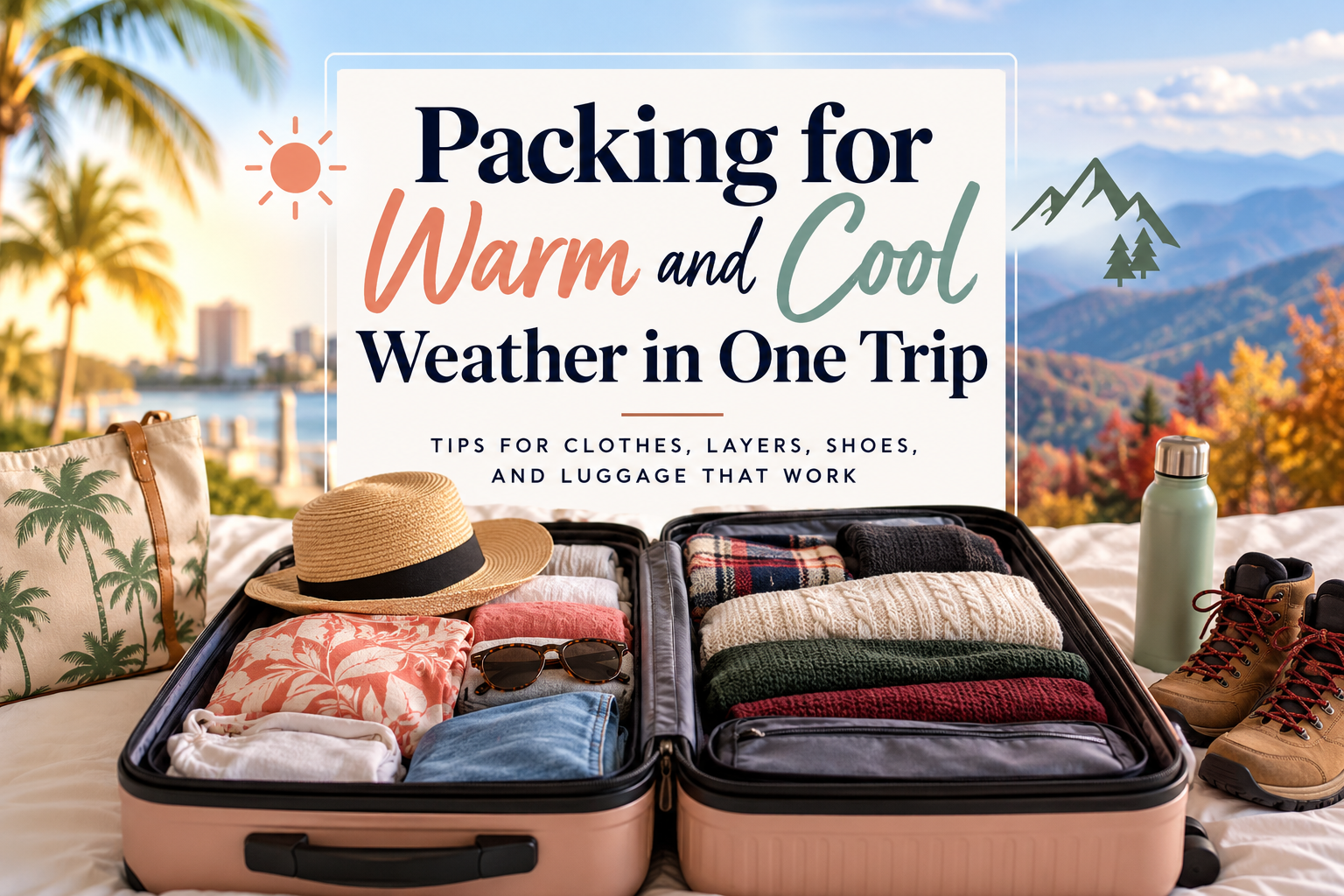

Packing for one kind of weather is easy.
Packing for Florida heat is one thing. Knowing you will then travel to cooler mountain mornings is another challenge. Packing for both can turn into a logistical nightmare.
That is where I am right now.
This trip starts warm, stays warm for a while, then shifts into places where I may actually need jeans, flannel, hiking shoes, and a jacket. I do not want to drag half my closet with me, but I also do not want to be cold because I convinced myself I could wear shorts everywhere.
So instead of packing one giant suitcase and hoping for the best, I break the trip into weather zones and pack around what I will actually need.
Using more than one suitcase works well for a road trip. For air travel, I would probably use different packing cubes for different climates instead.
I Start with the Warmest Part of the Trip
Florida is easy for me to picture.
Shorts. T-shirts. Comfortable shoes. Theme-park clothes. A light layer for aggressive air conditioning.
That part of the trip does not require much imagination because I already know what I like to wear when it is hot and humid.
The trick is not letting the warm-weather clothes take over the whole suitcase. I do not need ten different outfits for a few days just because I might want options.
I would rather pack a smaller group of clothes I know I will actually wear.
Then I Pack for the Cooler Part Separately
The cooler-weather clothes are where things get bulky fast.
Jeans take up more room than shorts. Hiking shoes take up more room than sandals. Flannel shirts, jackets, and thicker socks all add volume.
So I keep that part separate instead of mixing everything together.
For this trip, the cooler-weather suitcase gets the clothes I expect to use later: jeans, flannels, hiking clothes, wool socks, hiking boots, and a few layers I can add or remove depending on the temperature.
That way I am not digging through cold-weather gear while we are still in Florida.
Layers Matter More Than Heavy Clothes
I would rather pack layers than one giant heavy coat.
A T-shirt, flannel, and light jacket can handle a much wider range of temperatures than one bulky piece that only works when it is truly cold.
Layers also help when the day starts cool and warms up later.
That matters on trips where we may be outside for hours. Fossil hunting, gem hunting, hiking, or even just walking around a small town can feel completely different at 8 AM than it does at 2 PM.
Being able to peel off one layer at a time is much easier than carrying around a heavy jacket I no longer need.
I Pack Shoes by Activity, Not by Outfit
Shoes are one of the fastest ways to lose suitcase space.
I could easily justify bringing a different pair for every possible situation. I try not to.
Instead, I think about what we are actually doing.
Theme parks need comfortable walking shoes.
Hiking and outdoor stops need shoes with better grip and support.
Recovery shoes are worth bringing because after a long day, comfort matters more than matching an outfit.
That gives each pair a job.
If a pair does not have a clear purpose, it probably does not need to come.
I Keep the First Few Days Easy to Reach
One thing I do not want to do is unload everything at the first hotel.
For a multi-stop road trip, I like having a smaller suitcase with what we need for the first hotel night or first part of the trip.
That means I can leave the bigger bags packed until we actually need them.
It saves time, keeps the room less cluttered, and makes getting back on the road easier the next morning.
It also keeps me from tearing apart three suitcases because I packed one shirt in the wrong place.
I Do Not Pack for Every Possible Weather Emergency
This is the hardest part.
When I see a forecast with warm days, cool nights, rain chances, and changing temperatures, my first instinct is to pack for all of it.
That is how overpacking happens.
The better approach is to pack for the most likely conditions, then add a few flexible pieces.
A light rain layer makes sense.
A sweatshirt or flannel makes sense.
An entire winter wardrobe for one cool morning does not.
If the forecast changes dramatically, I can adjust before we leave. I do not need to solve every possible weather scenario weeks ahead of time.
Warm and Cool Weather Can Share Some Clothes
Not everything has to belong to one side of the trip or the other.
T-shirts work in both places.
A light long-sleeve shirt can work on its own or under another layer.
Comfortable walking shoes may work for several different stops.
Even some of the same basics can move from warm weather into cooler weather with the right layers.
The more pieces I can use in more than one way, the less I have to pack.
The Goal Is to Pack for the Trip I Am Actually Taking
It is easy to pack for imaginary versions of a trip.
What if it is colder than expected?
Maybe I’ll want one nicer outfit for dinner.
And somehow three extra pairs of shoes start sounding reasonable.
Most of those things never happen.
So I try to look at the actual itinerary, the actual weather, and the actual activities we have planned.
That gives me a much better answer than packing based on every possible what-if.
For this trip, that means warm-weather clothes for Florida and the theme parks, plus a separate group of cooler-weather and outdoor clothes for later stops.
It is still more luggage than I would take on a simple weekend trip.
But at least everything has a purpose.
And when one trip includes both hot afternoons and cool mornings, that is about as close to packing light as I am probably going to get.